
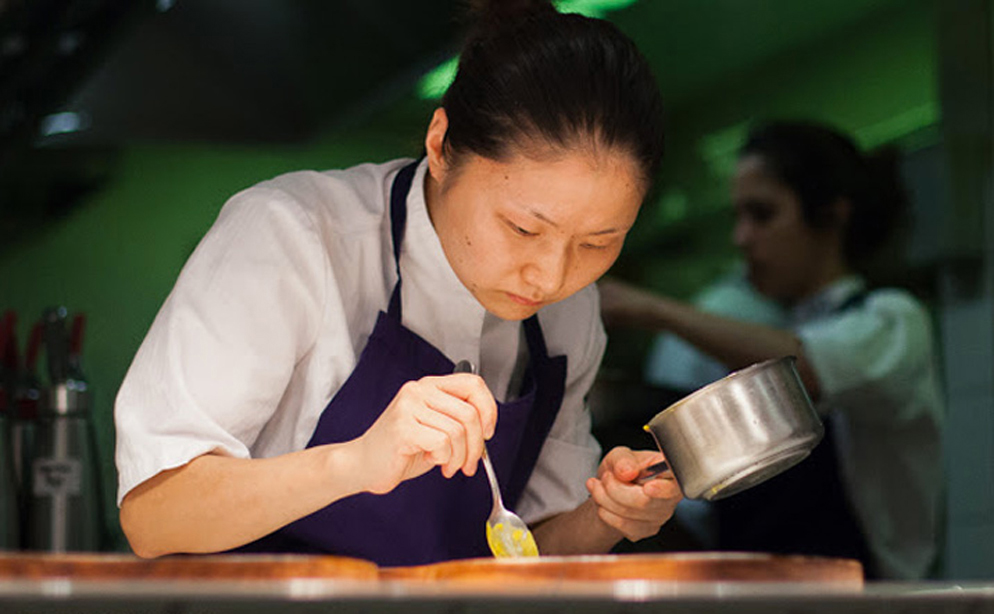
Chiho Kanzaki has been cooking for as long as she can remember. Growing up in Tokyo, she used to watch her father prepare dinner for their family and would climb onto a stool to imitate his movements in the kitchen. Like a lot of little girls enamored of the food world, she imagined herself as a baker or a patissier, but had never dreamed of becoming a chef with her own restaurant in Paris. Years later, she would come to see it as fate: Last spring, she launched the trendy eatery Virtus in the French capital's 12th arrondissment with her partner, fellow chef Marcelo Martin di Giacomo.

When Kanzaki left Japan for France 14 years ago she didn't have a job or any connections. Despite speaking little French, she was tenacious and implacable from the start.

"I sent out more than 200 letters of introduction and went directly to the restaurants that I wanted to work at, applying in person until I got a job," she recalls.
Her arrival coincided with an increase in the number of young Japanese chefs. Many of these immigrants began working their way up the hierarchy in some of the most prestigious restaurants in Paris and have gone on to open popular "neo-bistros" — restaurants that are redefining the global food scene by bringing sophisticated cooking techniques into casual settings. By the early 2000s, ambitious cooks such as Shinichi Sato (of Passage 53) and Kei Kobayashi (of Kei) had landed positions at Astrance and Plaza Athenee, respectively, and were paving the way for their compatriots. Kanzaki trained at four restaurants over the course of two years, but the experience was "a struggle," she says.

"At that time, all of the other Japanese chefs in Michelin-starred French kitchens were men in their mid-20s to mid-30s, but I was only 20, still inexperienced, and a woman."

She decided to go back to Japan and spent the next five years earning her chops at restaurants such as Miraville in Tokyo. Instead of continuing her career in her native country, she set her sights once again on Europe.

While the number of award-winning female chefs has risen recently, Japan still lags behind the rest of the world. The profession is particularly male-dominated in Japan. None of the nation's 29 establishments with three Michelin stars are helmed by women, and female Japanese chefs have yet to make it onto the prominent World's 50 Best Restaurants or Asia's 50 Best Restaurants lists.

"Especially for women in Japan, being a chef 10 years ago was very difficult," says restaurant consultant Ema Koeda, who trained at the Culinary Institute of America in Napa Valley, California. When Koeda was in school, she interviewed at a number of restaurants in Tokyo, but only one — Capricciosa, an Italian-themed family restaurant chain — considered her for a chef position. The combination of gender bias and long hours in the kitchen discourages many aspiring female chefs, who are more likely to work as consultants, recipe developers or food stylists.

"Today, it is possible to be a chef," says Koeda, "but still very tough if you want to be a mother and have a family."

When Kanzaki returned to France, she was 27 years old and completely focused on her career. During her seven-year tenure at Mirazur, the two Michelin-starred restaurant in Menton run by Mauro Colagreco, she worked furiously and ascended to the level of chef de cuisine. Her long years as a trainee had taught her to be disciplined and cautious: "If I had made one mistake in the kitchen, I would have not been given another chance because I was a woman. On the other hand, when I became chef de cuisine, I realized that I had a lot more opportunities than men occupying the same position," she says.

One such opportunity came in 2013, when she was invited to participate in the avant-garde event Gelinaz — an eight-hour dinner in Lima, prepared by 24 of the world's top chefs. Each created an interpretation of an octopus dish invented by Peruvian chef Gaston Acurio. Cooking alongside culinary luminaries such as Noma's Rene Redzepi and Osteria Francescana's Massimo Bottura, Kanzaki was one of only four women in the lineup. I attended the event and noticed her; she was young and apple-cheeked, but calm amid the chaos. After around five hours and 20 plates of the cephalopod in various guises, my powers of concentration waned, but I can still recall Kanzaki's dish. It was an elegant octopus salad dressed with citrus and capers and served with tapenade.

She brings the same delicacy and precision to her food at Virtus. The seasonal menu features contemporary French cuisine with an international accent: black mullet tartare, dotted with cream and avocado; beignets of white asparagus, dipped in batter and deep-fried like tempura; and roast whiting in a velvety bagna cauda sauce spiked with anchovy and garlic. The restaurant opened to acclaim, receiving favorable reviews in influential French food publications such as Le Fooding.

When I ask if she plans to start a restaurant in Japan someday, her answer is ambiguous: "I have to see how things go in Paris, but until then I have no desire to work in Japan," she says.

One thing, however, is clear. Kanzaki and Virtus are poised for success.

For more information, visit www.virtus-paris.com.